Guide
Commercial Refrigerator Gasket Replacement: Test, Cost, Fix
How to test a commercial refrigerator door gasket and its alignment, what replacement typically costs, and which seal fixes kitchen staff can handle.
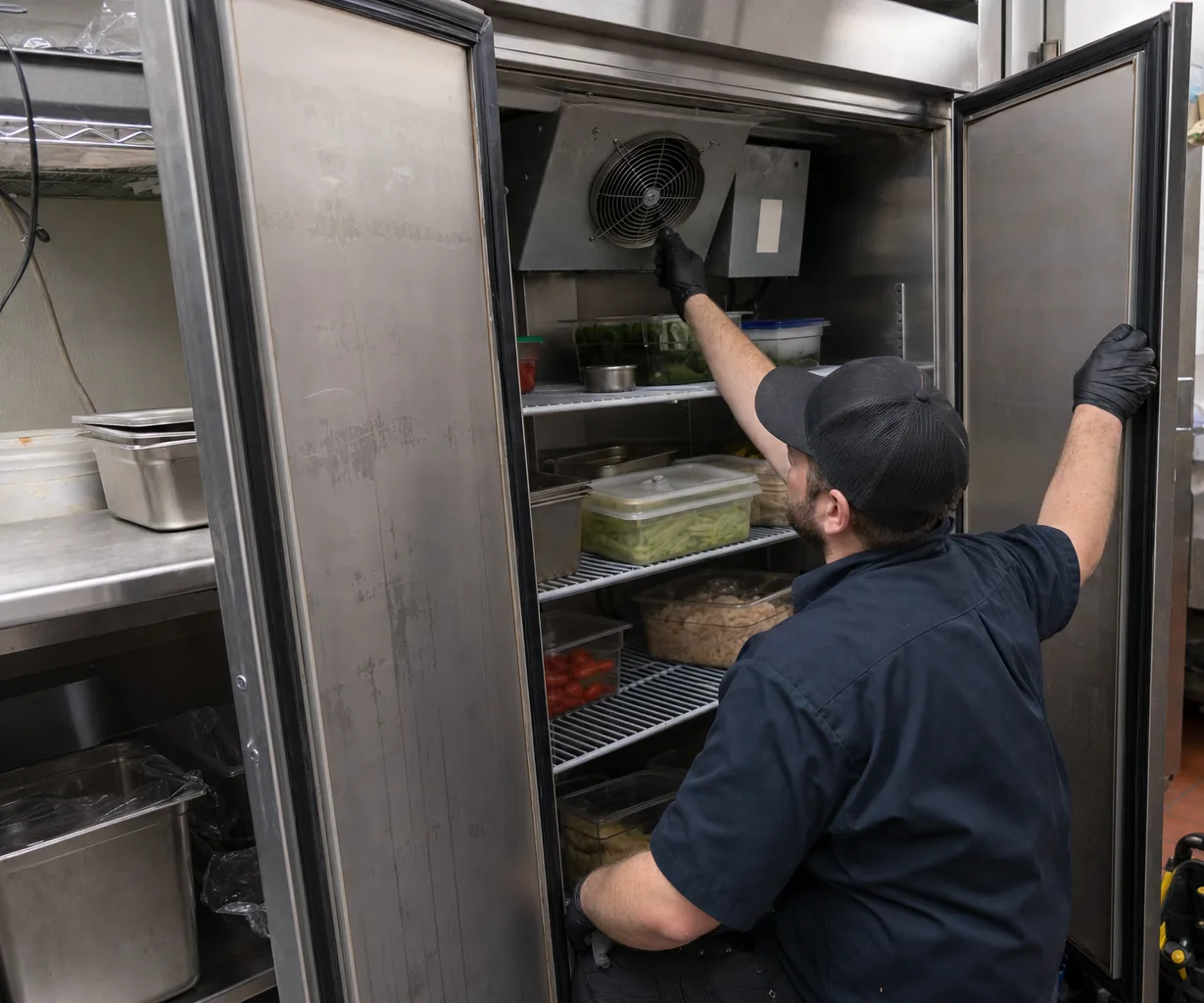
Commercial refrigerator gasket replacement means pulling the worn door seal out of its channel and fitting a new one made for that exact door, and on most reach-ins, prep tables and undercounters it is a 5-step job. Typical ranges for having a technician do it are $150–$500 per door, with the firm quote given on site after diagnosis, and it should happen as soon as a seal tears, goes stiff or fails the dollar-bill test below.
A bad gasket shows up as a cooler that runs all afternoon or a line cooler drifting above 41°F, the cold-holding limit inspectors check. In Hackensack, the Bergen County seat, the courthouse and county offices on Main Street bring a weekday lunch crowd to nearby kitchens, so that drift tends to land mid-rush.
How do you know a commercial refrigerator door gasket has failed?
Start with the dollar-bill test, which ENERGY STAR recommends for commercial refrigerator and freezer doors. Close the door on a bill, pull it out slowly, and repeat every few inches around all four sides. If the bill slides out easily anywhere, that section is not sealing and the door or gasket needs adjustment.
Then check the whole seal for torn corners (usually the bottom hinge side, where carts hit), flattened or rock-hard sections, spots pulled out of the channel, and frost at one point on a freezer door. Turbo Air notes that some condensation around the door edge is normal, so light sweat alone does not prove a failed seal; steady dripping or frost does. On Traulsen R & A Series controls, a recurring DOR OPN alarm means the door is reading open, so check that it fully closes before blaming anything else.
| Symptom | Likely cause | What staff can check | When to call a technician |
|---|---|---|---|
| Bill slides out easily on one side | Flattened or torn gasket section | Look for splits; reseat the gasket in its channel | Gasket torn or hardened along that side |
| Gap at the top latch corner | Door sagging on its hinges | Tighten hinge screws | Hinge, cam or closer worn or bent |
| Frost at one spot on a freezer door | Air leak at that point | Bill test at the frost line | Leak remains after reseating |
| Door will not stay shut | Cabinet out of level, weak closer | Legs or casters firm on the floor | Closer or door frame needs repair |
| Unit runs constantly, box above 41°F | Seal leak, dirty condenser or refrigeration fault | Bill test, then the condenser coil | Seal passes but temperatures still climb |
Is the problem the gasket or the door alignment?
A new gasket will not seal a door that hangs crooked, so check alignment before ordering parts. The gap between closed door and cabinet should be even all around; a wider gap at the top latch corner usually means the door has sagged on its hinges.
Then check the floor: a reach-in or prep table that is not level can rack the cabinet enough to open one corner. Turbo Air ties loud running noise to a weak floor or incorrectly set leveling feet, and the same uneven footing often keeps a door from closing squarely. Adjusting legs or locking casters is a staff job; replacing a worn hinge, cam or closer usually is not.
What does a failing gasket cost you in cooling?
Every gap lets warm, humid kitchen air into the box. The compressor runs longer, the evaporator coil frosts faster, and the products nearest the door, often the dairy and proteins your line pulls most, warm first. Held above 41°F too long, they must be discarded, and you lose covers on top of the inventory.
Frost on the coil also cuts airflow, so a small leak can look like a refrigeration fault. ENERGY STAR pairs its door-seal advice with cleaning the cooling coils and removing ice on them, because seal and coil work as a system. Fix the gasket first, then see whether the unit recovers before scheduling bigger work.
Can kitchen staff replace a commercial refrigerator gasket themselves?
Often, yes. Many reach-in and undercounter doors use a push-in gasket with a barbed edge that presses into a channel. A careful staff member can swap one in five steps:
- Note the model and serial number from the data plate and order the gasket made for that door.
- Let the new gasket and the unit reach room temperature. Traulsen requires this for its G-Series gaskets, and a cold gasket seats poorly on any brand.
- Pull the old gasket out, starting at a corner, and clean the channel with warm soapy water.
- Press the new gasket in, corners first, then work along each side so the barb seats fully.
- Close the door, let the gasket relax, then run the bill test on all four sides.
For Traulsen G-Series doors, the replacement is SVC-60256-00 for full height doors and SVC-60257-00 for half height doors, and the same gaskets fit solid and glass doors.
Are commercial fridge gaskets universal?
No. Gaskets differ by door size, profile (push-in, screw-in or magnetic) and corner design, and a generic seal cut to length rarely closes as well. Order by model and serial number through the manufacturer’s parts channel or a commercial parts distributor; for discontinued units, ask for a custom gasket built to the door’s measurements.
When should a technician handle the door seal instead?
Call for service when the gasket screws in behind a retainer strip, when a freezer door has a perimeter heater you could damage, when hinges or closers are worn, or when a new gasket still fails the bill test. Walk-in doors also deserve a technician, because gasket, sweep, hinges and heater wire work together. True’s foodservice warranty treats door gaskets as uncovered wear parts, so budget this as maintenance, not a warranty claim.
Hackensack Commercial Appliance Repair is an independent service, not manufacturer-authorized, covering Hackensack, Teaneck, Englewood, Paramus and nearby towns. The diagnostic visit has a typical range of $95–$165, credited toward the repair; see our commercial refrigeration repair and repair pricing pages, or call (914) 350-6776 to book a visit between services.
How do you make a new gasket last?
True’s T-Series schedule calls for checking the condition and seal of every gasket quarterly. Clean gaskets with warm soapy water, never scrape them with knives or sharp tools, and skip full-strength cleaning products. Traulsen’s G-Series EZ-Clean gaskets are Santoprene and safe to clean with bleach; on other brands, follow the manual. Don’t let staff prop doors open with sheet pans.
Frequently asked questions
Can you replace a commercial refrigerator gasket yourself?
Yes, on most push-in reach-in and undercounter doors, if you order the exact gasket by model and serial number. Screw-in gaskets, heated freezer doors and walk-in doors are better left to a technician.
How much does commercial refrigerator gasket replacement cost?
Typical ranges are $150–$500 per door, depending on door size and gasket type. The firm quote is given on site after diagnosis.
Are fridge gaskets universal?
No. Size, profile and corner design vary by model, so order by model and serial number or have a custom gasket made to the door’s measurements.
Is freezer or walk-in cooler gasket replacement different?
Yes. Freezer and walk-in doors often have heater wires, sweeps and heavier hinges, so a technician should check the whole door when the seal is replaced.