Guide
High-Temp Commercial Dishwasher: Temps, Logs and Fixes
The wash, final-rinse and dish-surface temperatures a high-temp commercial dishwasher must reach, how to log them, and what to do when they slip.
A high-temp commercial dishwasher sanitizes with heat instead of chemicals, so its final rinse has to enter the spray manifold at 180°F or hotter (165°F for a stationary-rack, single-temperature machine) and never above 194°F. That rinse must bring the dish surfaces themselves to at least 160°F, and most hot-water door-type machines also hold a wash tank of at least 150°F.
Those numbers are what a health inspector checks, and they are the first thing to slip when a booster heater or the building’s hot water falls behind. Here is how to read them, log them, and tell a supply problem from a repair.
What temperatures does a high-temp dishwasher need to hit?
The FDA Food Code sets the limits most local inspectors work from. Section 4-501.112 says the fresh hot-water sanitizing rinse, measured as it enters the manifold, must be at least 165°F on a stationary-rack, single-temperature machine and at least 180°F on every other type, with a ceiling of 194°F. Water hotter than that starts flashing to steam before it can pass its heat to the ware.
The rinse number is not the real goal; the dish is. The Food Code also requires utensil surfaces to reach 160°F during hot-water mechanical warewashing (4-703.11). Machines built to NSF/ANSI 3, the equipment standard for commercial dishwashers, must show a 99.999 percent (5-log) reduction of bacteria, with the same 165°F and 180°F final-rinse split.
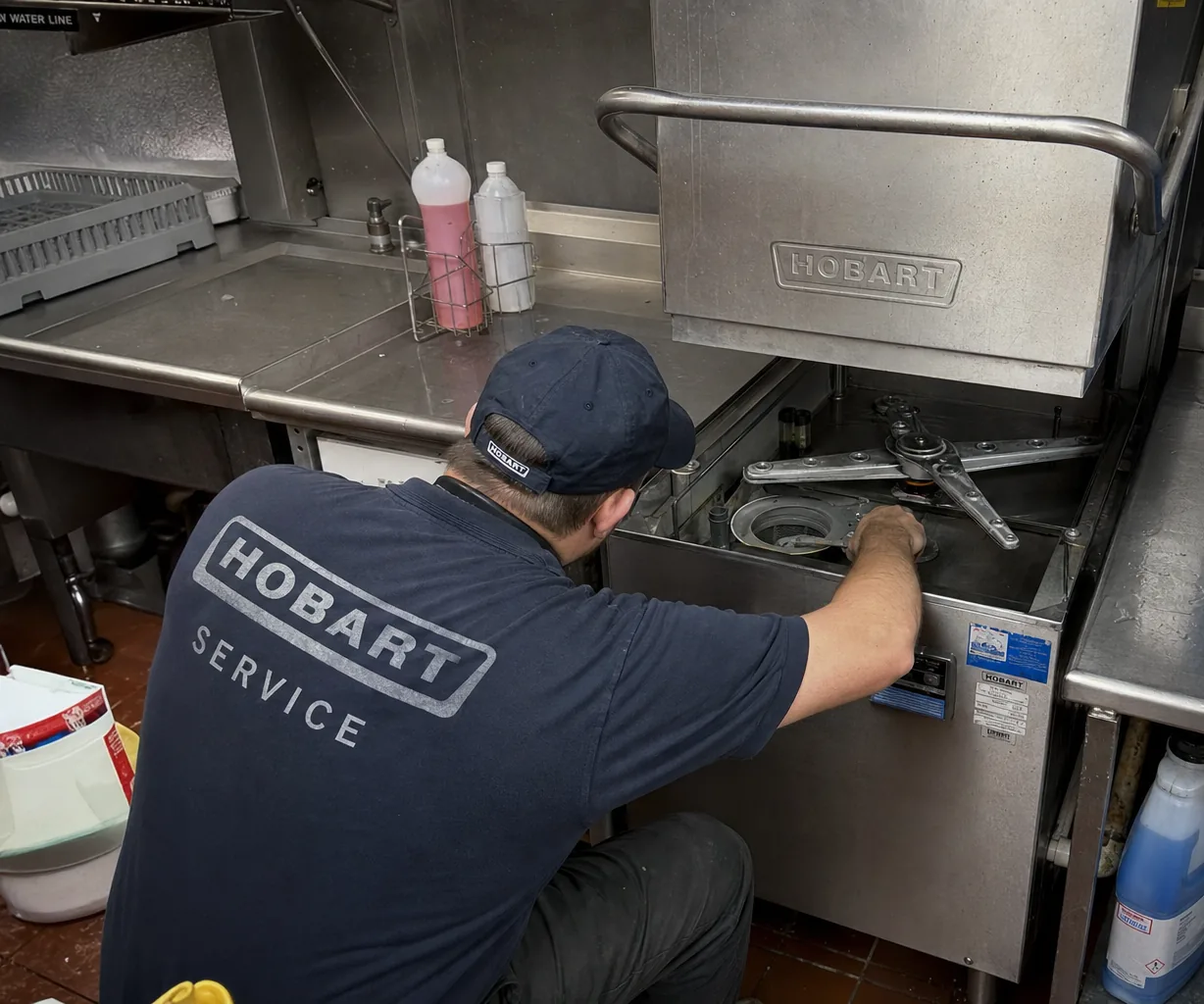
Manufacturers print their own minimums on the machine. On Hobart’s hot-water AM16 door-type models, such as the AM16-BAS and AM16-ASR, a label under the touchscreen controls lists 150°F wash and 180°F final rinse. Every dish shift should know those two numbers by heart.
How is a high-temp machine different from a low-temp one?
A low-temp machine runs cooler and relies on a sanitizer dose instead of heat. Hobart’s AM16SCB and AM16VLSCB are built for chemical sanitizing only, with minimums of 120°F wash and 120°F rinse, and their 4.3kW booster expects incoming water of at least 90°F (120°F recommended). A high-temp machine skips the chemical and dries ware faster, but it depends entirely on heat: a cold rinse means dishes that are not sanitized.
The hot-water AM16 models carry a 7.1kW frame-mounted electric booster that holds the 180°F final rinse as long as incoming water is at least 110°F. Ventless VL versions such as the AM16VL-BAS reach 180°F from cold water of at least 55°F. Knowing which version you own tells you what supply temperature the booster was sized for. See our commercial dishwasher page for the machine types we work on.
How do you log and verify dishwasher temperatures?
The Food Code requires an irreversible registering temperature indicator to be provided and readily accessible (4-302.13), because the display shows water temperature, not what the plate reached. In practice that means heat labels that change color permanently at 160°F, or a maximum-registering thermometer sent through on a rack.
A simple five-step routine for each shift:
- Before service, run two or three empty cycles so the booster and wash tank come up to heat.
- Log the wash and final-rinse readings, with the time and initials.
- Send a plate with a fresh indicator label through a normal cycle and confirm it registered 160°F. Stick the label on the log.
- Repeat the rinse check during the heaviest rush, when the booster works hardest.
- Note any low reading and the corrective action: machine stopped, three-compartment sink in use, service called.
A full log with corrective actions shows an inspector a kitchen that knows its machine.
Why do dishwasher temperatures drift?
Readings rarely fail all at once. They slide, usually for one of these reasons:
- Weak incoming hot water. If the building heater cannot keep the supply at the 110°F the booster was sized for, rinse temperatures sag late in a rush.
- Back-to-back cycles. A booster needs recovery time, and racking through without a pause can outrun it.
- Scale. Hard-water scale insulates heating elements, so they heat slower and fail sooner.
- A failed element, thermostat or probe. The display can look fine while the water is not.
- Gauge error. An old dial gauge can read high. The indicator label tells the truth.
Hackensack is the Bergen County seat, and in any busy kitchen that pushes racks hard through a lunch rush, booster recovery problems are the first to show up.
Newer controls flag the problem. A Hobart LXe displays LOW RINSE TEMP when a third consecutive cycle misses rinse temperature, and it keeps running. After 10 consecutive low-rinse cycles, the message changes to LOW RINSE TEMP Check Water Input, a strong hint that the supply is at fault.
What should you do when the rinse temperature will not hold?
| Symptom or message | Likely cause | What you can check | When to call a technician |
|---|---|---|---|
| Rinse low only during the rush | Booster recovery or weak supply | Space out racks; check hot water at the nearest tap | If it stays low with pauses |
| LOW RINSE TEMP Check Water Input | Incoming water too cold or low flow | Building water heater on; supply valve fully open | If the supply is hot and the message persists |
| Rinse low from the first cycle | Failed booster element or thermostat | Booster breaker tripped? | Right away |
| Wash tank below its labeled minimum | Tank heater, thermostat or low water level | Tank full; drain closing | If the tank is full and still cold |
| Display fine, label never hits 160°F | Probe or gauge error, clogged rinse arms | Clean rinse arms; retest with a new label | If a clean machine still fails |
While you wait, do not keep washing in a machine that cannot sanitize. Move ware to a properly set up three-compartment sink with chemical sanitizer, and give the technician your log; a week of numbers often points straight at the fault.
Building water heater work belongs to a plumber; a booster, thermostat, probe or control fault belongs to a dishwasher technician. Our commercial dishwasher repair team covers Hackensack plus Teaneck, Englewood, Paramus and Fort Lee. We are an independent service, not manufacturer-authorized.
What does a repair typically cost?
As typical ranges, a diagnostic service call runs $95–$165, and commercial dishwasher repair, Hobart machines included, runs $300–$1,100 depending on the part. The firm quote is given on site after diagnosis, before any work starts. Our repair pricing page lists other equipment. To book, call (914) 350-6776.
Frequently asked questions
What is the minimum final rinse temperature for a high-temp dishwasher?
It is 180°F entering the manifold for most machines, or 165°F for a stationary-rack, single-temperature machine, and never above 194°F. The dish surfaces must reach 160°F.
Can I keep using the dishwasher if the rinse reads 170°F?
Not for sanitizing on most machines, because anything other than a stationary-rack, single-temperature unit needs 180°F. Switch to a three-compartment sink with sanitizer and call (914) 350-6776.
Does a high-temp dishwasher need a booster heater?
Almost always, because building hot water rarely arrives at 180°F. Hobart’s hot-water AM16 uses a 7.1kW booster that needs incoming water of at least 110°F.