Guide
Walk-In Cooler Failures: How to Prevent a Costly Inventory Loss
Spot a failing walk-in cooler early, know what to do the moment one warms up, and learn the maintenance that prevents a costly overnight inventory loss.
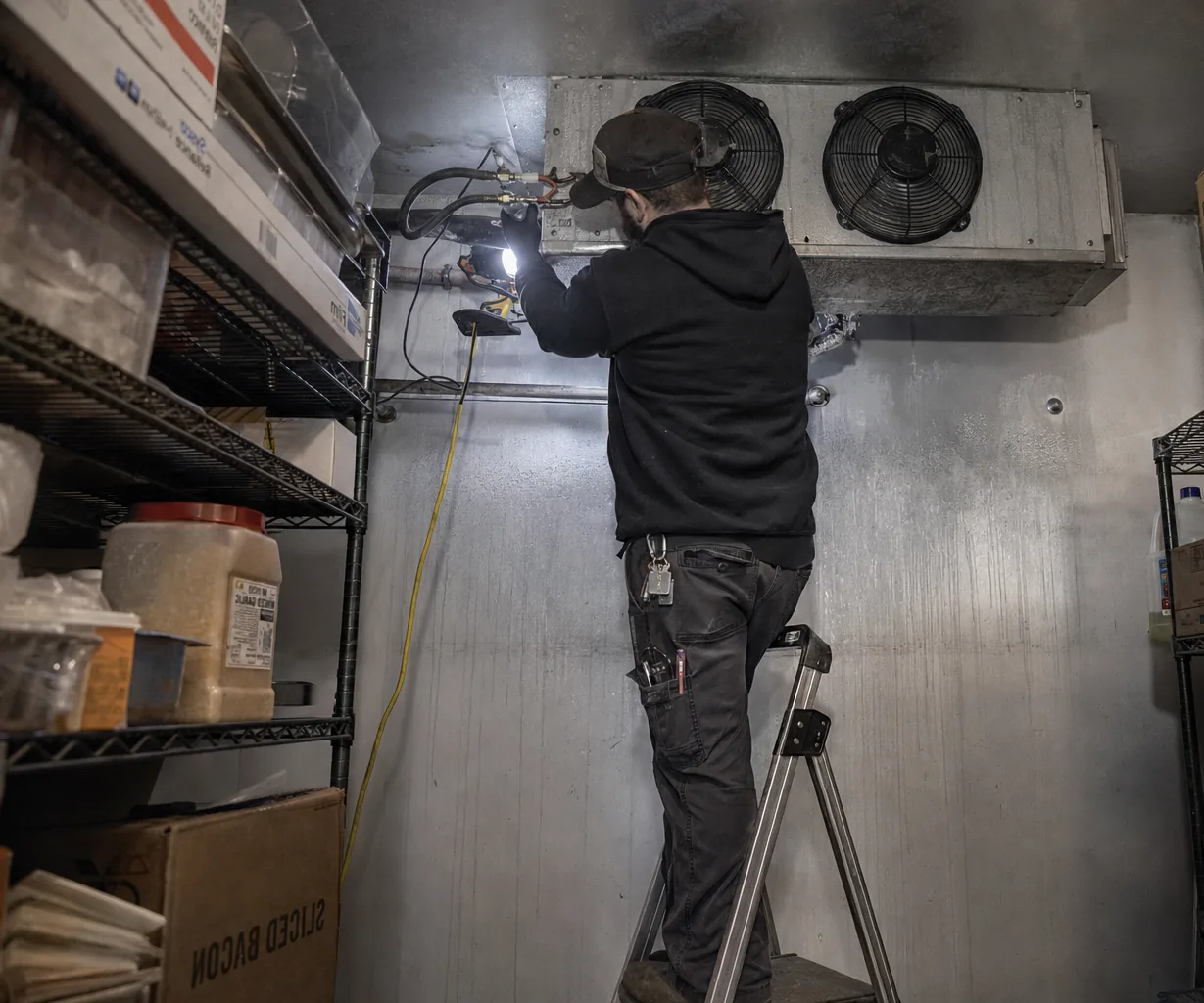
Nothing in a restaurant represents more risk than the walk-in. When a walk-in cooler or freezer drifts warm overnight, you can lose thousands of dollars of product in a single shift — plus the menu items you can’t serve until you restock. The good news: most walk-in disasters are preventable, and most give you warning signs first if you know what to look for.
The early warning signs
A walk-in rarely dies all at once. Watch for these tells:
- Slow recovery. The box takes noticeably longer to pull back down to temperature after a busy stocking period. This is the single most common early warning.
- Longer or more frequent run times. The condensing unit runs almost constantly instead of cycling.
- Ice where there shouldn’t be any. Frost building on the evaporator coil, the floor, or around the door usually means a defrost fault or a door that isn’t sealing.
- Water on the floor. A blocked condensate drain or melting coil ice.
- A door that doesn’t pull shut. A failed closer or worn sweep gasket lets warm, humid air pour in all day.
Any one of these means it’s time to call before a small fault becomes a full warm-up.
What to do the moment a walk-in starts warming
If you catch a walk-in climbing, act fast to protect product:
- Keep the door shut. Every opening dumps in warm air and speeds spoilage.
- Move the most perishable, highest-value product to another working cooler or freezer if you have one.
- Check the obvious. Is the condenser blocked, iced, or filthy? Is the unit even running? Is the door fully closed?
- Call for emergency service. A good commercial tech will prioritize a product-at-risk call and stabilize the box before diagnosing.
The maintenance that prevents it
Walk-in failures are overwhelmingly driven by two things: dirty condensers and bad doors.
- Keep the condenser coil clean. Grease and dust choke heat rejection and are the number-one cause of warm boxes and failed compressors. Schedule professional cleaning on a regular interval.
- Service the door system. Closers, sweep gaskets and door seals are cheap and are the most overlooked cause of icing, energy waste, and temperature drift.
- Confirm the defrost cycle works. A defrost fault ices the coil until airflow — and cooling — stops.
- Monitor and log temperatures. Continuous monitoring catches drift before it becomes an overnight loss.
The bottom line
A walk-in compressor or sealed-system repair can run from $1,200 to $4,000 — but that’s a fraction of a spoiled inventory plus lost service. Preventive maintenance is the cheapest insurance in the building. If your walk-in is showing any warning sign, don’t wait for it to fail on a Friday night. Call our dispatch line for same-day and 24/7 emergency walk-in service across Hackensack and Bergen County.